 +1 (305) 721-3023
  +52 (55) 5273 7586
 +57 (601) 390-9561
 +55 (11) 91298-4219
How AI Is Transforming US Marketing Agencies (2026)
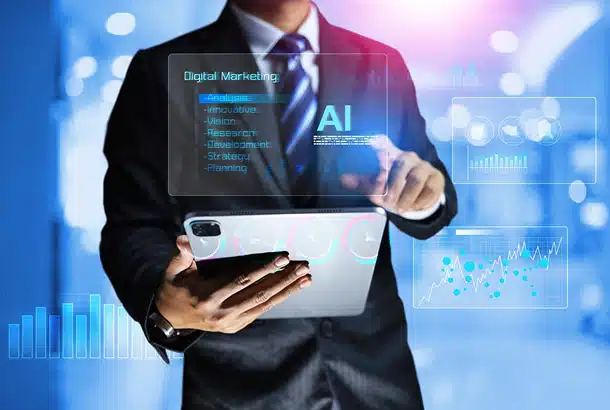
Artificial intelligence (AI) is no longer an experimental add-on for digital marketing agencies—it has become a core strategic layer that defines how agencies operate, deliver value, and compete across the U.S. market.
In one of the world’s most competitive marketing ecosystems, AI is reshaping agency operations, core services, pricing models, and client expectations. Agencies that integrate AI as a competitive advantage are building more scalable business models, a shift widely discussed by marketing leaders and industry analysts.
This guide explores how AI is transforming digital marketing agencies in the United States, what this shift means for brands operating in the U.S., and how agencies are preparing for AI-driven search, Generative Engine Optimization (GEO), and the next era of digital growth.
Executive Summary: AI in Digital Marketing Agencies (2026)
- AI is now embedded across agency operations, strategy, and service delivery.
- Agencies use AI to automate execution, improve decision-making, and personalize campaigns at scale.
- Pricing models are shifting from retainers to outcome-based engagements.
- Human expertise remains essential for strategy, ethics, and brand leadership.
- Brands should evaluate agencies based on how AI is governed, measured, and integrated into strategy—not just the tools used.
Why Does AI Matter for Digital Marketing Agencies in the U.S.?
In the United States, where brands compete aggressively for attention and growth, AI is no longer just about efficiency—it has become a high-impact strategic capability with measurable business outcomes in marketing performance.
Agencies that integrate AI into their workflows through AI-driven digital marketing systems are able to:
- Generate faster and more accurate insights.
- Personalize messaging and customer experiences at scale.
- Automate repetitive, resource-intensive processes.
- Optimize campaigns continuously rather than periodically.
- Improve ROI through predictive and data-driven decision-making.
How Is AI Changing Day-to-Day Operations in Digital Marketing Agencies?
AI adoption is transforming how agencies work internally and how quickly they deliver value to clients—shifting teams away from manual execution and toward higher-impact strategic work.
Automated Data Analysis & Insights
AI-powered platforms enable advanced analytics and marketing attribution, reducing manual reporting while accelerating insight generation. This allows agencies to move from data to action faster and with greater confidence.
Speed, Efficiency, and Scale
Processes such as audience segmentation, competitive analysis, and reporting are increasingly automated, reflecting broader research on AI-driven productivity.
Continuous Optimization
Machine learning enables real-time campaign tuning and ongoing improvement—turning optimization into a continuous process rather than a periodic task.
How Is AI Transforming Core Marketing Services?
AI-Powered SEO & Content Strategy
Modern agencies rely on AI-powered SEO strategies to interpret search intent, cluster keywords, and identify content gaps. These workflows are grounded in proven AI applications in modern marketing.
One example of this evolution is the Human-Centered Content Optimization (HCCO) approach, originally conceptualized by ABC Digital. This methodology reframes SEO as an intent-driven, experience-aligned discipline, where content is designed not just to rank, but to be semantically understood and conversationally structured for search engines and large language models (LLMs). As AI systems shift from keyword matching to contextual interpretation, agencies must build content ecosystems optimized for clarity, discoverability, and AI citation.
In 2026, this extends to Generative Engine Optimization (GEO), the practice of optimizing content for visibility, citation, and brand presence within AI-generated search results and large language models—rather than traditional search rankings alone.
AI in Paid Media & Performance Marketing
AI has transformed performance advertising through AI-optimized paid media management, enabling predictive ROAS modeling, automated bidding, and real-time creative optimization. These capabilities allow agencies to move from reactive adjustments to proactive, data-led performance strategies.
AI in Analytics, Attribution, and Measurement
AI-driven attribution models help agencies connect cross-channel customer behavior to outcomes, improving budget allocation and decision-making across increasingly complex customer journeys.
Three Levels of AI Adoption in Digital Marketing Agencies
This framework reflects broader analysis of workplace automation and helps brands assess agency maturity.
Brands should prioritize agencies operating at Strategic or Business Model AI levels, as these are better equipped to translate AI capabilities into measurable growth.
1. Operational AI
- Reporting and dashboard automation
- Bid and budget management
- Content drafts and optimization
- Audience segmentation
2. Strategic AI
- Predictive analytics and forecasting
- Multi-touch attribution modeling
- Personalization frameworks
- GEO, aligned with the definition of generative search
3. Business Model AI
- Outcome-based pricing
- AI-native service offerings
- Scalable advisory and consulting models
Agencies operating at this level use AI not just to execute—but to redefine how value is created and priced.
How AI Is Reshaping Agency Business Models
From Hours to Outcomes
As AI accelerates delivery, agencies are moving away from hourly billing toward value-based pricing models, a trend frequently highlighted by marketing executives and industry research.
Strategic Specialization
Rather than offering generic services, agencies specialize in AI-enhanced capabilities such as AI SEO, predictive analytics, and automation—reflecting broader trends in AI marketing.
What AI Does—and Does Not—Replace
AI enhances execution and insight, but it does not replace:
- Strategic judgment
- Brand positioning and narrative
- Ethical accountability
- Client relationship management
In agency environments, AI works best as a force multiplier for human expertise—not as a replacement for leadership, judgment, or accountability.
Risks and Challenges in AI Adoption
Despite its benefits, AI introduces risks such as over-automation, data bias, privacy concerns, and governance gaps. Addressing these challenges requires a focus on ethical AI in digital marketing and strong human oversight in AI-driven marketing.
What This Means for Brands Choosing a Digital Marketing Agency
Brands evaluating partners should prioritize agencies that demonstrate strategic AI integration, not just tooling. This mindset is essential when choosing an AI-forward digital marketing agency.
AI Search, GEO, and the Future of Agency Visibility
As search shifts toward generative answers, agencies must optimize for AI-powered discovery. Strong strategies rely on AI marketing strategy frameworks and a solid understanding of the AI-driven information retrieval ecosystem.
The Future of AI in Digital Marketing Agencies (2026 and Beyond)
AI adoption continues to expand into autonomous agents, AI-native operating models, and real-time decision frameworks—trends increasingly analyzed in research on AI and organizational strategy.
Conclusion: AI as a Strategic Advantage—Not a Shortcut
AI is fundamentally reshaping how digital marketing agencies in the U.S. operate. The most successful agencies use AI to enhance strategy, improve outcomes, and deepen client value—an approach consistently reinforced by industry leaders and market research.
For brands, the real opportunity lies in partnering with an AI-native marketing agency that treats AI as a long-term strategic asset—ensuring technology amplifies creativity, insight, and sustainable growth.